The Brain Behind The Podium
"Individuals who start from a balanced, energy-efficient nervous system have more flexibility to respond to changing demands."
- Kristen Nash
For two weeks, our social media feeds are inundated with all things Olympics: team kits, athlete village tours, moments of jaw-dropping performance, and pure heartache. For a brief window, we get a front-row seat to what human athletic potential looks like on a global stage.

At this level, outcomes are decided by hundredths of a second and millimeters of precision. One run, one routine, one shot where everything either clicks, or it doesn’t. From the outside, we see extraordinary physical preparation and assume the body is the deciding factor. But elite athletes don’t lose Olympic medals because they forgot how to skate, jump, or land. They win or lose because of timing, decision-making, emotional regulation, confidence, fatigue, focus, and stress. In other words, brain states: the brain’s moment-to-moment mode of operation that shapes how effectively an athlete can think, feel, and perform under pressure.

"Just like heart rate, brain activity speeds up and slows down depending on what the athlete is doing."
This is where neurofeedback has quietly gained traction in high-performance sport as a scientific way to train the brain with the same intentionality athletes apply to strength, conditioning, and technical skill. Neurofeedback measures and trains patterns of brain activity, often referred to as brainwaves, which reflect how activated or calm the nervous system is in any given moment. Just like heart rate, brain activity speeds up and slows down depending on what the athlete is doing.
Athletes typically show a calm, efficient neural baseline before performance. Their nervous system is balanced rather than over-aroused or disengaged, with steady breathing, relaxed but ready muscles, clear outward attention, and conserved energy. At the brain level, this reflects stable patterns linked to relaxed readiness and controlled movement, not stress or mental drift.
When performance begins, this baseline shifts smoothly into focused activation rather than a surge of effort. Alpha activity reduces only in task-relevant areas to sharpen attention, while beta increases briefly and locally to support precise movement and timing. Mild frontal theta supports present-moment flow states. Overall, brain activity becomes quieter and more synchronized, allowing performance to feel fluid, efficient, and repeatable under pressure.
Let’s look at these brain wave shifts in two very different Olympic events:
Biathlon
Biathlon is one of the most mentally demanding Winter Olympic sports. Athletes ski at near-maximal physical intensity, driving heart rate and arousal high. In these moments, fast brain activity supports power, effort, and rapid decision-making. But within seconds of arriving at the shooting range, the athlete must downshift. Precision shooting requires calm, steady brain states that support stillness, breath control, and fine motor precision. If stress-related activation remains elevated, hands shake, muscles tighten, thoughts rush, and targets are missed, not because of poor technique, but because the nervous system has not shifted gears quickly enough.
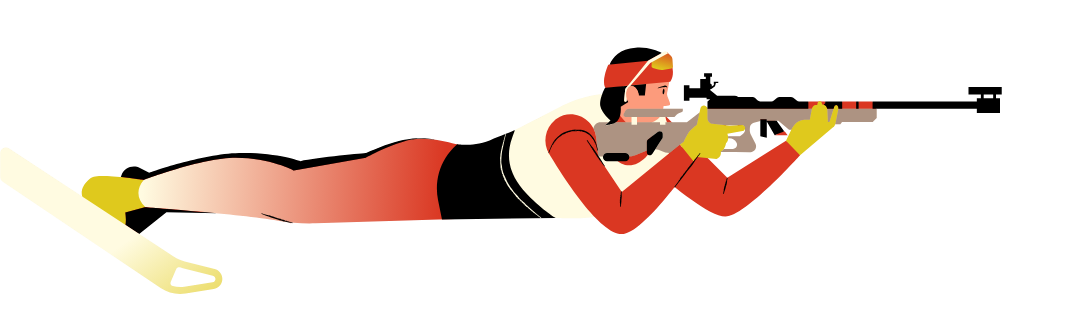
Figure Skating

Figure skating offers a different but equally revealing example. Successful skating depends on rhythm, timing, balance, and emotional regulation as much as strength and technique. When the nervous system holds a calm, efficient baseline, movement feels smooth and jumps unfold with natural timing. If that baseline is unstable, muscles tighten and timing feels rushed. If stress-driven brain activity spikes, attention turns inward and analytical, often leading to overthinking mid-routine, the moment when a jump that has been automatic for years suddenly breaks down. Elite skaters tend to maintain calm, efficient baseline states, layering in focused activation only at moments that demand precise takeoff and landing.
The Olympics and Beyond
For the athletes and the spectators alike, the average person relies on brainwave regulation to meet the demands of daily life. Different tasks require different brain states: focused attention at work, emotional regulation during difficult conversations, creative thinking when problem-solving, and the ability to downshift for rest and sleep. For example, someone may need a more activated, focused state to analyze a report or meet a deadline, then the capacity to shift into a calmer state to drive home in traffic, be present with family, or fall asleep at night.
When the brain gets stuck in one mode, for instance, chronically over-activated from stress or under-engaged from fatigue, functioning suffers in familiar ways, such as irritability, poor concentration, overthinking, or difficulty sleeping. Regulation is not about being calm all the time, but about matching brain states to the task at hand.
Across Olympic sport and everyday life alike, performance and well-being are strongly linked to this ability to regulate baseline states. Individuals who start from a balanced, energy-efficient nervous system have more flexibility to respond to changing demands. When the nervous system is chronically over-activated or under-engaged, pressure amplifies those patterns, increasing errors, emotional reactivity, and mental fatigue.
The Olympics are not just another competition; they are a pressure cooker unlike anything else. Athletes spend years, often decades, preparing for a single moment. The stakes are global, the margins microscopic, and the environment unfamiliar: new beds, new time zones, altered routines, and relentless attention. From a nervous system perspective, it is a perfect storm. A certain level of activation is helpful; too little and performance feels flat, too much and the system tips into fight-or-flight. Muscles tighten, breathing becomes shallow, vision narrows, fine motor control drops, and decision-making suffers. At the Olympic level, these subtle shifts can determine whether an athlete stands on the podium or watches from the stands.
Neurofeedback makes sense in this context because elite athletes already understand how to train things you cannot see. They work on reaction time, proprioception, rhythm, timing, and feel. Neurofeedback extends that mindset inward. It helps athletes (and non-athletes) recognize what a regulated, ready baseline feels like and trains the nervous system to return to it more efficiently under stress. Rather than hoping to feel “right” when it matters, individuals build familiarity with more optimal states through repeated training.

The demands of Olympic competition also make nervous system recovery critical. Heats, finals, travel, media, and team obligations are often compressed into a few intense days. Athletes with regulated nervous systems can settle efficiently, recover faster, sleep better, and maintain clearer thinking across events. The same capacity to downshift supports everyday recovery as well, protecting against burnout and chronic stress.
When we watch the Olympics, we are witnessing more than strength and speed; we are watching nervous systems engaging and balancing in extraordinary circumstances. Neurofeedback does not replace talent, grit, or years of training, but for some athletes, and for many people outside elite sport, it helps foster the conditions where effort, skill, and resilience show up when they are needed most.
If you are looking for additional support get in touch with us HERE or by calling 587-333-6349. 💙 At Sano State Psychology, we are always happy to help.
References
Hatfield, B. D., Haufler, A. J., Hung, T.-M., & Spalding, T. W. (2004). Electroencephalographic studies of skilled psychomotor performance. Journal of Clinical Neurophysiology, 21(3), 144–156. https://doi.org/10.1097/00004691-200405000-00003
(Neural efficiency, calmer and more synchronized brain activity in elite performers.)
Del Percio, C., Babiloni, C., Bertollo, M., Marzano, N., Iacoboni, M., Infarinato, F., … Eusebi, F. (2009). Visuo-attentional and sensorimotor alpha rhythms are related to visuo-motor performance in athletes. Human Brain Mapping, 30(11), 3527–3540. https://doi.org/10.1002/hbm.20776
(Task-specific alpha modulation, attention, and motor precision.)
Baumeister, R. F. (1984). Choking under pressure: Self-consciousness and paradoxical effects of incentives on skillful performance. Journal of Personality and Social Psychology, 46(3), 610–620. https://doi.org/10.1037/0022-3514.46.3.610
(Performance breakdown under pressure due to attentional and emotional shifts.)
Vernon, D. (2005). Can neurofeedback training enhance performance? An evaluation of the evidence with implications for future research. Applied Psychophysiology and Biofeedback, 30(4), 347–364. https://doi.org/10.1007/s10484-005-8421-4
(Foundational review supporting neurofeedback for performance and self-regulation.)
Disclaimer
Our content is for informational and educational purposes and is not a replacement for professional advice, diagnosis, or treatment. If you're facing mental health concerns, please seek help from a qualified professional for personalized guidance. Every individual's situation is unique, so use the information here at your discretion. While we strive for accuracy, the field of psychology is ever-evolving, and our content may not always reflect the latest research. Please prioritize your privacy by avoiding sharing personal information in comments or interactions. Your well-being is our top concern, so use our content for educational purposes, but remember to rely on professionals for your specific needs.


