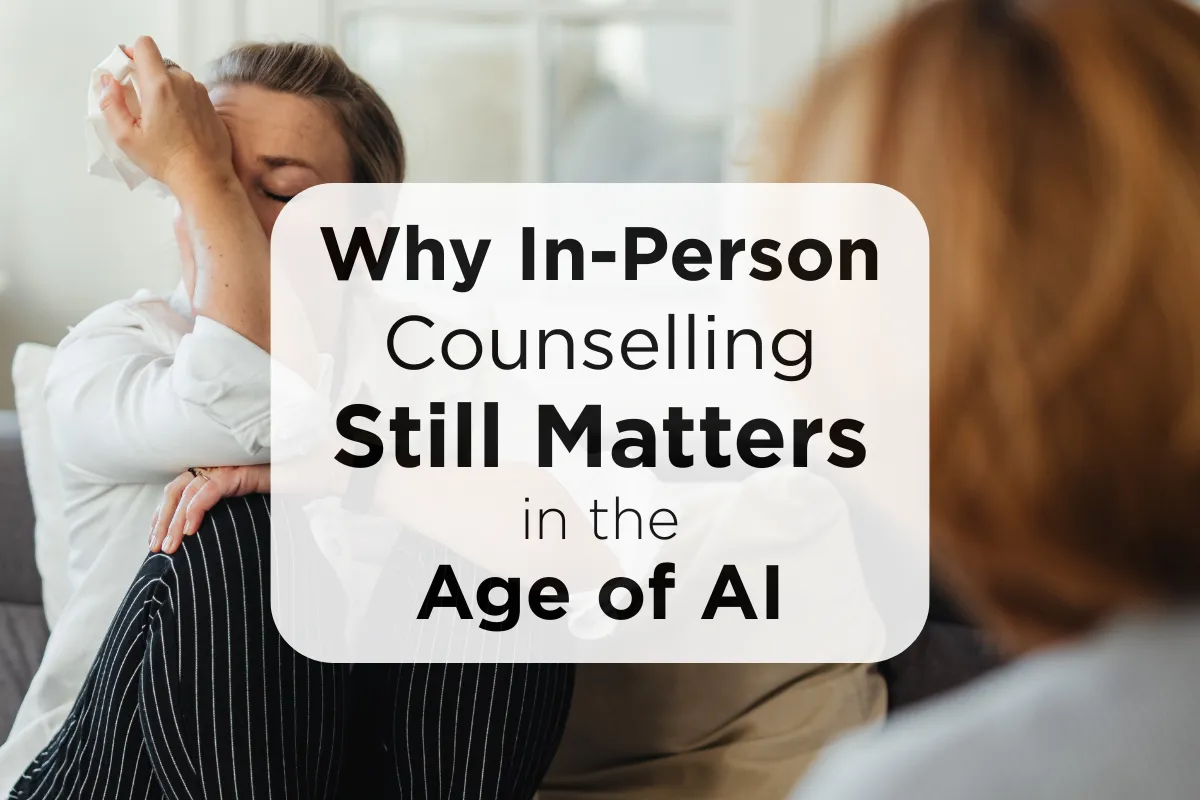
Why In-Person Counselling Still Matters in the Age of AI
What if the problem is not that people lack answers, but that they lack connection?
- Jarom MacDonald
We are entering a time where you can open an app, type out your thoughts, and receive a response that feels thoughtful, supportive, and even empathic. AI can simulate the language of therapy remarkably well, but there is a critical question beneath all of this:
Is therapy really about getting the right response, or is it about being deeply understood by another human being?
The short answer is that therapy works because of the relationship, not just the conversation.

The Power of the Therapeutic Alliance
One of the most well-established findings in psychotherapy research is the importance of the therapeutic alliance, which refers to the collaborative and emotional bond between a therapist and their client.
One group of researchers (Horvath and colleagues, 2011) describe the therapeutic alliance as an agreement on goals, agreement on tasks, and the development of a personal bond. The bond is not a secondary factor–it is central to the effectiveness of therapy.
Another group of researchers (Flückiger et al. 2018) looked at the outcome of 295 studies, which included more than 30 000 patients. They found that therapeutic alliance, the collaboration and partnership built with a therapist, was the strongest and most consistent predictor of how well therapy worked. This was true even though the client concerns and therapy approaches were different across the various studies.
This means that no matter the technique, therapy works best with a strong human connection.
The Role of Empathy in Healing
Closely tied to the therapeutic alliance is empathy, which is the ability to accurately understand and resonate with the someone’s emotional experience. Elliott et al. (2018) conducted a comprehensive meta-analysis and found that therapist empathy has a moderate and reliable association with positive therapy outcomes. This relationship has been demonstrated across many studies and clinical settings.
Empathy is not simply about choosing the right words. It involves tone, timing, facial expression, and the ability to respond in a nuanced and moment-to-moment way.
These are processes that emerge naturally in human interaction.
What AI Can Do and What It Cannot
AI can generate thoughtful responses and reflect emotional language in ways that feel supportive. It can be useful for education, reflection, and even initial support.
However, there is a fundamental difference between simulated empathy and lived empathy.
A human therapist is not just producing responses. They are observing subtle emotional shifts, responding to body language, and adjusting their approach in real time. The interaction is dynamic and reciprocal.
This creates something AI cannot replicate, which is authentic relational presence.

The Importance of Co-Regulation
Another key element of in-person counselling is co-regulation, where one person’s regulated nervous system helps stabilize another’s.
When a client is in the presence of a calm and attuned therapist, physiological processes such as heart rate, breathing, and emotional intensity can shift. This is not only psychological. It is biological.
Schore (2012) emphasizes that therapeutic change is deeply connected to right-brain processes, which involve nonverbal communication, emotional attunement, and relational experience.
AI does not have a nervous system and cannot participate in this type of regulation.
Rupture, Repair, and Growth
Therapy is not always a smooth process. Misunderstandings and moments of disconnection can occur.
Safran and Muran (2000) highlight that repairing these ruptures is a key mechanism of change. When a therapist and client work through a misunderstanding, it strengthens trust and builds emotional resilience.
This process depends on a real relationship between two people.

The Bottom Line
AI can provide information. It can simulate supportive dialogue. It can be a helpful tool in certain situations.
But therapy is not only about what is said. It is about what is experienced in the presence of another human being.
Research consistently shows that empathic connection and the therapeutic alliance are central to meaningful psychological change.
These are inherently human processes.
Final Thoughts
For many people, the issue is not a lack of insight.
It is a lack of connection.
AI may continue to evolve, but real human connection remains essential in the process of healing.
If you're looking to find a human connection, reach out to us at info@SanoState.com . I am currently taking new clients, and hope to offer you support through your healing journey.
References
Horvath, A. O., Del Re, A. C., Flückiger, C., & Symonds, D. (2011). Alliance in individual psychotherapy. Psychotherapy (Chicago, Ill.),48(1), 9–16. https://doi.org/10.1037/a0022186
Flückiger, C., Del Re, A. C., Wampold, B. E., & Horvath, A. O. (2018). The alliance in adult psychotherapy: A meta-analytic synthesis. Psychotherapy, 55(4), 316–340. https://doi.org/10.1037/pst0000172
Elliott, R., Bohart, A. C., Watson, J. C., & Murphy, D. (2018). Therapist empathy and client outcome: An updated meta-analysis.Psychotherapy (Chicago, Ill.),55(4), 399–410. https://doi.org/10.1037/pst0000175
Safran, J. D., & Muran, J. C. (2000). Negotiating the therapeutic alliance: A relational treatment guide. Guilford Press.
Schore, A. N. (2012). The science of the art of psychotherapy. W. W. Norton & Company.